Does an EV Charger Require a Panel Upgrade? How to Calculate Your Home's Load Capacity
Updated: Jun 12, 2026
Worried plugging in your new EV will plunge your home into darkness? Find out if your electrical panel can handle the extra load, learn how to calculate your home's capacity step-by-step, and understand why a 200-amp service upgrade is required.
You’re ready to say goodbye to the gas pump, plug in your shiny new electric vehicle at night, and wake up to a "full tank." But as you start researching home charging, you keep seeing the same scary phrase pop up on forums and electrician websites: electrical panel upgrade.
Now you’re staring at that grey metal box in your basement, wondering if your home can actually handle this new energy demand. Will plugging in your car plunge your entire house into darkness? Do you really need to shell out for a full-service upgrade?
Here at Loch Monster Electric, we get asked these questions almost every single day. Let's break down how to evaluate your electrical panel capacity for an EV charger, how to calculate your home's current load capacity, and how to figure out if your system is ready for the transition.
If you are looking for details on the physical layout of your garage, conduit runs, or local Minnesota rebates, jump over to our companion guide EV Charger Installation at Home: What Twin Cities Homeowners Actually Need to Know. Today, we are focusing strictly on the math and physics inside your breaker panel!
Signs Your Electrical Panel Is Already Overloaded
Before we even touch the math of adding a new EV charger, we need to look at how your home is currently behaving. Your electrical panel is the heart of your home’s electrical system. If it’s already struggling, adding an EV charger which draws a massive, continuous load for hours at a time is going to push it over the edge.
Keep an eye out for these telltale signs electrical panel is overloaded:
- Frequent Tripping Breakers: If running your microwave while your central air is on constantly trips a breaker, your system is already operating at its physical limit.
- Flickering or Dimming Lights: Do your lights dim slightly when the refrigerator compressor or the vacuum cleaner kicks on? That’s a sign of voltage drop under sudden, heavy loads.
- Warm Panel Door or Strange Odors: If you touch your panel cover and it feels warm, or if you smell a faint "fishy" or burning plastic odor, turn off your main breaker immediately and call an electrician. This is a severe fire hazard.
- Humming or Buzzing: A quiet electrical panel is a happy electrical panel. Buzzing, crackling, or sizzling sounds indicate loose connections or failing breakers.
If you are experiencing any of these issues, you must address them immediately before they turn into a major, costly electrical emergency. Only then will your home be ready for an EV charger installation.
Understanding Your Electrical Panel Capacity for an EV Charger
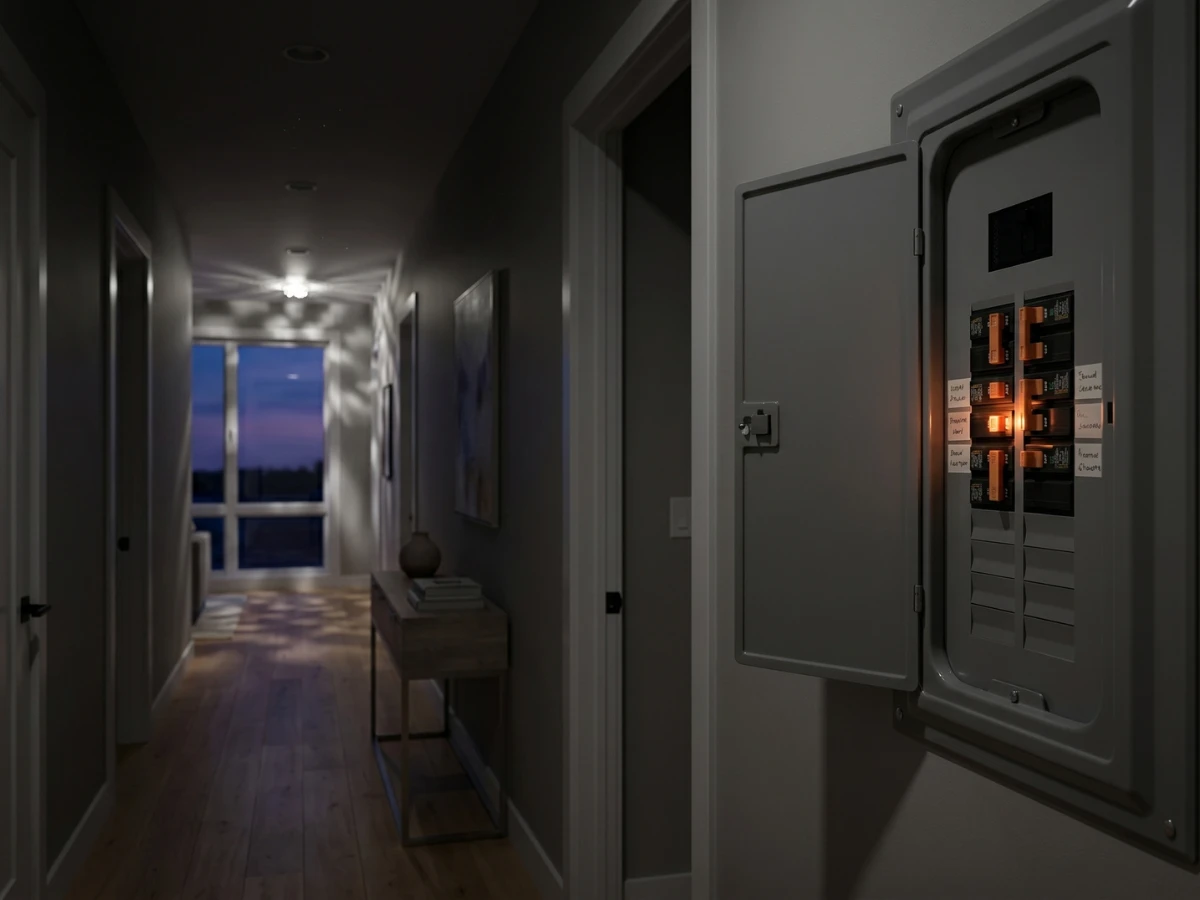
Most homes built in the Twin Cities before the 1980s were equipped with 60-amp or 100-amp electrical services. Modern homes, on the other hand, typically feature 200-amp services to accommodate heavy-duty HVAC systems, double ovens, hot tubs, and modern appliances.
To understand your electrical panel capacity for an EV charger, you need to look at the continuous nature of EV charging. An EV charger runs at maximum output for several hours straight. Because of this, the National Electrical Code (NEC) mandates that the circuit breaker and wiring must be rated for 125% of the charger's continuous load.
For example:
- A 32-amp charger requires a 40-amp breaker (32 Amps x 1.25 = 40 Amps).
- A 40-amp charger requires a 50-amp breaker (40 Amps x 1.25 = 50 Amps).
If you already have a 200-amp panel, you likely have plenty of capacity to spare. But what if you are dealing with a 100-amp panel EV charger setup? Let's look at the realities of that scenario.
The 100 Amp Dilemma: Can You Make It Work?
Can you safely run a 100-amp panel EV charger?
The short answer is: Maybe, but you have to be careful, and you might have to compromise on charging speed.
If your home has a gas range, gas water heater, and gas furnace, your baseline electrical draw is relatively low. In this case, you might have just enough wiggle room to install a lower-amperage Level 2 charger (like a 16-amp or 24-amp unit on a 20-amp or 30-amp circuit).
However, if your home relies entirely on electricity with electric heat, an electric range, an electric water heater, and central air, adding an EV charger to a 100-amp panel is a recipe for tripped main breakers. In these "all-electric" homes, a panel upgrade is almost always non-negotiable for safety.
How to Do an Electrical Load Calculation for EV Charging
To figure out exactly where your home stands, we have to perform an electrical load calculation for EV charging. This isn't just about adding up the numbers printed on your circuit breakers (if you did that, your total would easily exceed your main breaker limit, which is normal because you don't run every appliance at the same time).
Instead, the NEC uses a specific "demand load" calculation. Let's walk through a realistic, complete example for a typical 1,800-square-foot home that uses gas heating and a gas water heater, but has an electric dryer, an electric stove, and a central air conditioner.
Step 1: Calculate the General Lighting and Appliance Load
The NEC assumes a baseline load of 3 Watts per square foot of living space for general lighting and outlets. Next, we must add 1,500 Watts for each small appliance branch circuit (typically kitchen outlets, with a minimum of two required by code: 3,000 Watts total) and another 1,500 Watts for the laundry circuit.
- General Lighting: 1,800 sq. ft. * 3 Watts = 5,400 Watts
- Kitchen Circuits: 2 circuits * 1,500 Watts = 3,000 Watts
- Laundry Circuit: 1 circuit * 1,500 Watts = 1,500 Watts
- Total Baseline Load: 5,400 + 3,000 + 1,500 = 9,900 Watts
Step 2: Apply the Demand Factor
Because you rarely turn on every single light, outlet, toaster, and vacuum cleaner simultaneously, the NEC allows us to apply a "demand factor" discount to this baseline:
- Take the first 3,000 Watts at 100% capacity = 3,000 Watts
- Take the remaining wattage at 35% capacity = (9,900 Watts - 3,000 Watts) * 0.35 = 6,900 Watts * 0.35 = 2,415 Watts
- Adjusted General Load: 3,000 Watts + 2,415 Watts = 5,415 Watts
Step 3: Add Fixed Appliances at Nameplate Rating
Next, we add the actual wattage ratings for heavy-duty, fixed appliances. You can find these on the metal manufacturer labels on your appliances. For our example home, we will add:
- Electric Range/Cooktop: 6,000 Watts (a moderate range)
- Electric Clothes Dryer: 5,000 Watts
- Dishwasher: 1,200 Watts
- (Note: The water heater and furnace run on gas in this example, so they only draw trivial amounts of electricity for control boards and are excluded here.)
- Total Fixed Appliance Load: 6,000 + 5,000 + 1,200 = 12,200 Watts
Step 4: Add HVAC Loads
Compare your air conditioning load to your heating load. Because you won’t run both at the same time, we only add the larger of the two numbers at 100% capacity.
- Central Air Conditioner: 4,000 Watts (approx. 17 Amps)
- Gas Furnace Blower Motor: 1,000 Watts
- Larger HVAC Load to Add: 4,000 Watts
Step 5: Convert Watts to Amps
Now, we add up all our adjusted wattages from Steps 2, 3, and 4 to find our total adjusted house wattage:
- 5,415 Watts (Step 2) + 12,200 Watts (Step 3) + 4,000 Watts (Step 4) = 21,615 Watts
To convert this total wattage into amperage (which matches your panel's limit), we divide the wattage by your home's standard nominal voltage (240 Volts):
- Amps = Total Adjusted Watts / 240 Volts
- Amps = 21,615 Watts / 240 Volts = 90.1 Amps
What This Calculation Means: Why Your 100-Amp Panel Can't Handle It
In this 1,800-square-foot home, our calculated baseline demand load is 90.1 Amps.
If your home has a standard 100-amp electrical panel, this calculation shows you have about 9.9 Amps of remaining headroom. Now, let's look at the math of trying to squeeze an EV charger onto this panel:
- Existing House Demand Load: 90.1 Amps
- Standard 32-Amp Level 2 EV Charger (requires a 40-Amp circuit breaker): 40 Amps
- New Total Potential Load: 90.1 Amps + 40 Amps = 130.1 Amps
Because 130.1 Amps is 130% of your panel's maximum capacity, trying to squeeze this charger onto your existing setup is an electrical impossibility that will instantly overload your system and put your home at serious risk.
When Do You Need a Service Upgrade for an Electric Vehicle?
If your load calculation shows that your home's existing electrical demand is already pushing your panel's limits, it’s time to talk about a professional upgrade.
A panel upgrade doesn't just mean swapping out the physical breaker box on your wall. A true service upgrade involves:
- Upgrading the heavy utility lines coming into your home (coordinating with providers like Xcel Energy or CenterPoint here in the Twin Cities).
- Installing a new, heavy-duty weatherhead, mast, and outdoor meter socket.
- Replacing your old panel with a modern 200-amp panel with brand-new, highly reliable circuit breakers.
While this represents a larger upfront investment, it completely future-proofs your home. Not only will you be able to charge your EV at maximum speed, but you’ll also have the capacity to add heat pumps, induction cooktops, or solar panels down the road without worrying about overloading your electrical system.
If you suspect your panel is overdue for retirement, take a look at our residential electrical panel upgrade page to see how our team handles these seamless upgrades safely, quickly, and with full local permitting.
Let Loch Monster Electric Handle the Math
Calculating residential load capacity can get complicated fast. Guessing incorrectly or misinterpreting code rules can lead to local code violations, melted wires, voided homeowner's insurance policies, or worse.
At Loch Monster Electric, our licensed, local Minnesota electricians can perform a professional load calculation using specialized diagnostic equipment. We’ll look at your home’s electrical layout, test your panel's current health, and give you an honest recommendation on whether you can safely install your charger on your existing panel or if a service upgrade is the smartest, safest move for your family.
Ready to get your garage EV-ready? Reach out to Loch Monster Electric today, and let's get you safely plugged in!
Frequently Asked Questions
A panel upgrade involves replacing your old physical breaker box with a new one that contains safer, modern circuit breakers and more space for new circuits, but it keeps your home's existing total electrical limit. A service upgrade means actually increasing the amount of electricity your home can pull from the utility grid, such as jumping from a 100-amp capacity to a 200-amp capacity. A service upgrade requires running heavier wires from the utility line into your home and installing a new meter socket outside.
For most residential homes, a standard panel or service upgrade takes between 4 and 8 hours to complete. Because we have to coordinate directly with your local utility provider to safely disconnect and reconnect the main power lines, your electricity will be shut off for a portion of the day. Our team works efficiently to minimize this downtime, ensuring your power is back on and your new system is fully tested and safe by the time evening rolls around.
The winter cold changes your real-world electricity usage. In freezing weather, your EV battery requires extra energy just to warm itself up before it can even begin storing a charge, which can cause the vehicle to draw maximum continuous power for longer stretches of time. Additionally, your home's heating systems, garage space heaters, and water heaters work significantly harder during a polar vortex. If your load calculation shows your panel is already skating on thin ice capacity-wise, Minnesota’s brutal winter spikes make a safe panel upgrade even more critical.