
High Ceilings & Sloped Roofs: How to Choose and Install a Vaulted Ceiling Fan
Updated: Jul 20, 2026
Installing a vaulted ceiling fan requires careful structural, mechanical, and safety considerations beyond standard installations. Proper downrod lengths ensure optimal airflow, while specialized sloped adapters prevent joint binding and motor strain on steep pitches. To handle kinetic vibration, National Electrical Code standards mandate fan-rated steel support boxes. Because high-altitude setups demand specialized staging equipment, hiring a licensed electrician ensures precise dynamic balancing and safe, code-compliant installation.
Choosing and installing a ceiling fan on a vaulted ceiling is far from a standard home improvement project. Because these fixtures sit on an incline at extreme heights, the process involves precise geometric calculations, specialized high-altitude staging equipment, and critical structural load considerations that go far beyond a standard light fixture.
This comprehensive guide breaks down the exact math, critical hardware additions, and electrical safety codes required to safely install a high-ceiling fan. Read on to discover how matching the right structural support with proper extensions ensures a premium system that performs flawlessly without a single wobble, click, or buzz.
The Geometry of Airflow: The Ultimate Ceiling Fan Downrod Length Guide
A fan mounted flush against an incline or left hanging too close to a high ceiling cannot move air effectively. This placement starves the blades of the surrounding air needed to create a proper downdraft, resulting in an inefficient, noisy system that strains the motor. To optimize whole-home HVAC efficiency and truly balance indoor temperatures, the fan blades must sit at the correct height.
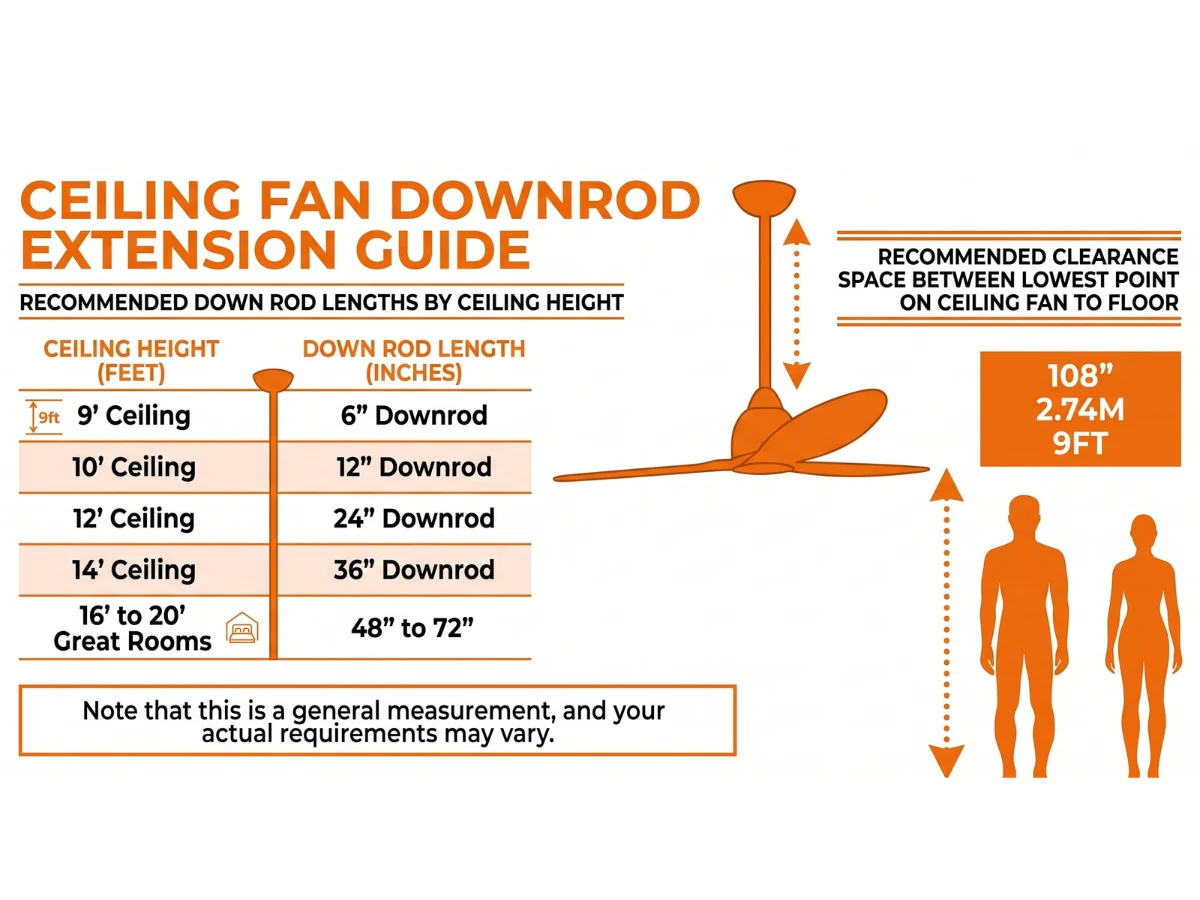
As a standard industry rule of thumb, ceiling fan blades should hang between 8 and 9 feet above the finished floor, maintaining an absolute minimum safety clearance of 7 feet. In grand, two-story great rooms or custom vaulted spaces stretching 16 to 20 feet high, substantial extension rods are required to lower the fixture into the active living zone.
Homeowners can use this ceiling fan downrod length guide to map out their room dimensions:
- 9-Foot Ceiling: 6-inch downrod
- 10-Foot Ceiling: 12-inch downrod
- 12-Foot Ceiling: 24-inch downrod
- 14-Foot Ceiling: 36-inch downrod
- 16-Foot to 20-Foot Great Rooms: 48-inch to 72-inch downrods
*Note that this is a general measurement, and your actual requirements may vary. If you are ready to schedule a ceiling fan installation, call us at 763-292-1191 or send us a message.
In wide-open architectural layouts, such as the custom properties found throughout Maple Grove or Woodbury, selecting the precise extension length is crucial. It preserves the clean aesthetic symmetry of a luxury room while ensuring the motor operates safely.
Conquering the Incline: Why You Need a Sloped Ceiling Adapter for a Fan
The Steep Pitch Challenge vs. Standard Mounts
Standard ceiling fan hardware is built with flat ceilings in mind. Most factory-included mounting canopies possess a standard ball-and-socket configuration that can only pivot or self-level up to a 15- or 20-degree angle. However, custom vaulted roofs and architectural great rooms frequently feature a much steeper pitch—such as a 10/12 or 12/12 slope. When attempting to attach standard hardware to these sharp angles, the pivot joint binds completely, forcing the downrod to hit the side of the canopy housing and preventing the fixture from hanging straight.
Universal Sloped Mounts and Blade Clearance Physics
The solution requires a specialized sloped ceiling adapter, commonly known in the trade as a cathedral ceiling canopy. This specialized ceiling adaptor replaces the standard bracket. It lets the fan assembly flex safely and hang perfectly plumb—perpendicular to the earth—even at angles up to 60 degrees.
Bypassing this hardware introduces a significant safety hazard. When a spinning fan runs at an angle, gravity pulls unevenly on the motor bearings. Over time, this imbalance wears down the internal parts, causes a constant clicking noise, and can loosen the mounting fasteners.
Homeowners must also ensure that the distance from the furthest tip of the fan blade to the nearest sloped wall or drywall surface measures at least 18 inches. Preserving this gap prevents an aerodynamic phenomenon known as "blade slap" or wall buffering, where compressed air bounces off the wall, creating an annoying rhythmic thumping noise and destabilizing the fixture's balance.
The Hidden Overhead Threat: Structural Box Upgrades
The Core Risk of Static Outlets
Swapping a standard builder-grade hanging light fixture for a heavy, high-velocity fan on a high ceiling creates a major safety liability. Standard blue plastic or thin metal electrical boxes are engineered strictly to support static weight—meaning dead weight that hangs completely motionless. They are not structurally equipped to manage the mechanical demands of an active appliance.
The Danger of Kinetic Dynamic Stress
A spinning ceiling fan generates severe kinetic vibrations and a downward pulling force that amplifies significantly when distributed through a long extension downrod. Under the toll of this recurring torque, an unrated electrical box will slowly fracture. Furthermore, the extreme seasonal humidity shifts common across the Upper Midwest cause residential wooden framing to expand and contract. This structural movement, paired with the active wobble of an unrated box, causes smooth factory framing nails to slowly back out of the ceiling joists over time, creating a major overhead collapse hazard.
National Electrical Code Requirements and Steel Support Braces
To address these critical safety threats, the National Electrical Code (NEC) strictly mandates the use of a fan-rated outlet box that features an explicit stamp marking it as "Acceptable for Fan Support." In standard architectural retrofits where finished upper floors or sealed rooflines remove attic access, installing these safety foundations requires a fan-rated outlet box.
A licensed electrician for high ceilings must thread a heavy-duty, expandable steel support brace up through the existing drywall opening. Once positioned between the parallel ceiling joists, the brace is mechanically expanded until its heavy steel teeth lock directly into the wooden framing structure. This support system creates a rigid, code-compliant anchor point capable of neutralizing dynamic kinetic forces. This ensures that the heavy overhead fixture remains securely locked in place for the long haul.
Logistics of High-Altitude Installations: Scaffolding, Ladders, and Safety
The Dangers of Installing a Ceiling Fan on a Vaulted Ceiling
Installing a fan at 15 to 25 feet up in a two-story great room or custom sloped ceiling is far riskier than standard electrical work. Standard retail A-frame ladders from a home improvement store are entirely insufficient for these high-altitude installations. They lack the height and stable footprint required to complete an install safely. Attempting to balance on an unstable ladder while wrestling with a heavy motor hub at a significant elevation is very dangerous.
Staging with Specialized Gear to Protect Pristine Spaces
Safely hoisting, wiring, and anchoring a 50-pound premium architectural fan requires heavy-duty industrial staging equipment. Professional technicians utilize industrial-grade multi-task articulation ladders, targeted scaffolding towers, or indoor-safe protective lift mechanisms. This specialized rigging machinery ensures that the installer remains fully stabilized while doing the work. This allows meticulous connection adjustments and precise calibration.
Beyond technician safety, installing a high-altitude fan requires a deliberate layout strategy to protect the home. Hiring a professional trade team guarantees that heavy staging elements and metal scaffolding components are assembled and disassembled according to code. This ensures that custom drywall remains entirely unblemished, freshly finished exotic hardwood floors are safely blanketed against scratches, and delicate custom paintwork remains completely immaculate from start to finish.
Why You Need a Licensed Electrician for High Ceilings
Professional Calibration and Risk Mitigation
Partnering with an experienced, specialized two-story living room fan installer guarantees long-term performance and complete peace of mind. A licensed electrician for high ceilings provides expertise that extends far beyond splicing basic copper wires together. A professional trade expert executes meticulous load-bearing math, secures full structural code compliance, and carefully calibrates the final assembly. Using precise micro-weights, they dynamically balance the fan blades to neutralize microscopic weight variations, entirely eliminating high-altitude wobbles, clicking, or motor strain from day one.
Modern premium fixtures engineered for high ceilings utilize complex wireless remote receiver modules, dedicated wall-switch transmitters, or automated smart home integration kits. If a low-grade or incorrectly wired control module fails twenty feet up in the air, troubleshooting it requires deploying heavy scaffolding platforms all over again just to swap a tiny chip. Professional electricians prevent this logistical headache by deploying industrial-grade components and heavy-duty receiver hardware. This maximizes the thermal stability and provides years of uninterrupted service.
For a complete look at full-service structural overhead installations, explore our Ceiling Fan Installation Services.
Conclusion
A soaring vaulted ceiling deserves an architectural fixture that performs flawlessly, runs quietly, and enhances your home without a single tremor or motor buzz. For long-term reliability, you must look beyond a fan's cosmetic finish to anchor the mechanical, structural, and electrical framework hidden high behind the drywall.
Before investing in an expensive new fixture, homeowners throughout Maple Grove, Woodbury, and the Twin Cities are encouraged to book a professional, on-site assessment. Proactive auditing ensures your ceiling's junction box rating, sloped adapters, and downrod dimensions perfectly align with the space's unique spatial configuration.
Ready to secure your overhead investment? Call Loch Monster Electric at 763-292-1191 today or message us.
Frequently Asked Questions
Vaulted ceilings hold significantly higher volumes of air, so standard 42-to-52-inch fans are often insufficient. For large open-concept rooms or great rooms (300–500+ sq ft), choose a 60-to-72-inch blade span delivering 6,000+ CFM (Cubic Feet per Minute). Larger blades move greater volumes of trapped upper-air lower into living zones at lower RPMs without motor noise.
When installing downrods reaching 36 to 72 inches, standard factory fan lead wires are rarely long enough. You must extend the wiring by splicing matching gauge wires (typically 14 AWG) using UL-listed wire connectors or heat-shrink tubing before threading them through the rod. Always ensure wire splices remain fully accessible inside the electrical junction box rather than trapped inside the hollow downrod.
Yes, but it requires running new electrical lines from an active circuit or switch box through the ceiling framing. Because vaulted ceilings typically lack accessible attic space above, this process involves cutting small access points in drywall to fish wire through joists and installing a heavy-duty retrofit ceiling fan brace to bridge the structural framing securely.