
Cold-Weather and Snow-Season Factors That Shape Minnesota Parking Lot Lighting Decisions
Updated: Aug 28, 2026
This guide covers the cold-weather and snow-season factors that affect commercial parking lot lighting in Minnesota, including freeze-thaw pole movement, ice-load risks, snow glare, and salt corrosion. It also covers practical fixes, warning signs to watch for, and answers to common questions.
Minnesota winters put real stress on the poles, wiring, and fixtures of parking lot lighting systems. If you manage a commercial property or an HOA anywhere from Eden Prairie to Woodbury, you've probably dealt with a pole light that flickers all winter, then quits the week it finally warms up.
That's not bad luck. It's physics. Frozen ground moves, salt eats metal, and snow piles block light where you need it most. This is why commercial parking lot lighting in Minnesota has to be designed to stand up to Minnesota weather. It can't just be installed and forgotten.
At Loch Monster Electric, we get calls every fall and spring from property managers dealing with the same handful of cold-weather problems. In this article, we'll walk through the cold-weather and snow-season factors that cause most parking lot lighting problems, cover what can actually be done to prevent them, and show you the warning signs to watch for on your own property.
Call our team at 763-292-1191 before winter hits or fill our contact form and we’ll get in touch with you.
The Cold-Weather Factors Working Against Your Lighting
Listed below are the main forces that damage or degrade parking lot lighting in Minnesota. Most of them build up slowly over several winters before a light actually fails.
How Cold Weather Affects Parking Lot Lights
Cold air itself usually isn't the problem. Quality LED fixtures handle sub-zero temperatures without losing brightness. They also start up faster in the cold than older bulbs do.
Older HID fixtures (metal halide or high-pressure sodium) are the ones that struggle. They dim and take longer to warm up when it's cold out, just when you need full lights the most.
The real damage comes from what winter does around the fixture, not inside it:
- Moisture gets in. Worn seals let water in, then it freezes and cracks lenses or corrodes connections inside.
- Temperature swings cause stress. A 40-degree day followed by a subzero night stresses gaskets and wiring until they fail.
- Snowplows and skid loaders hit poles. Equipment used for clearing the lot can clip poles and arms during a routine plow run.
This is one reason more properties are switching to LED parking lot lighting in Minnesota for winter reliability. But even the best LED fixture will fail early if the pole base, wiring, or mounting hardware underneath it weren't built for our winters.
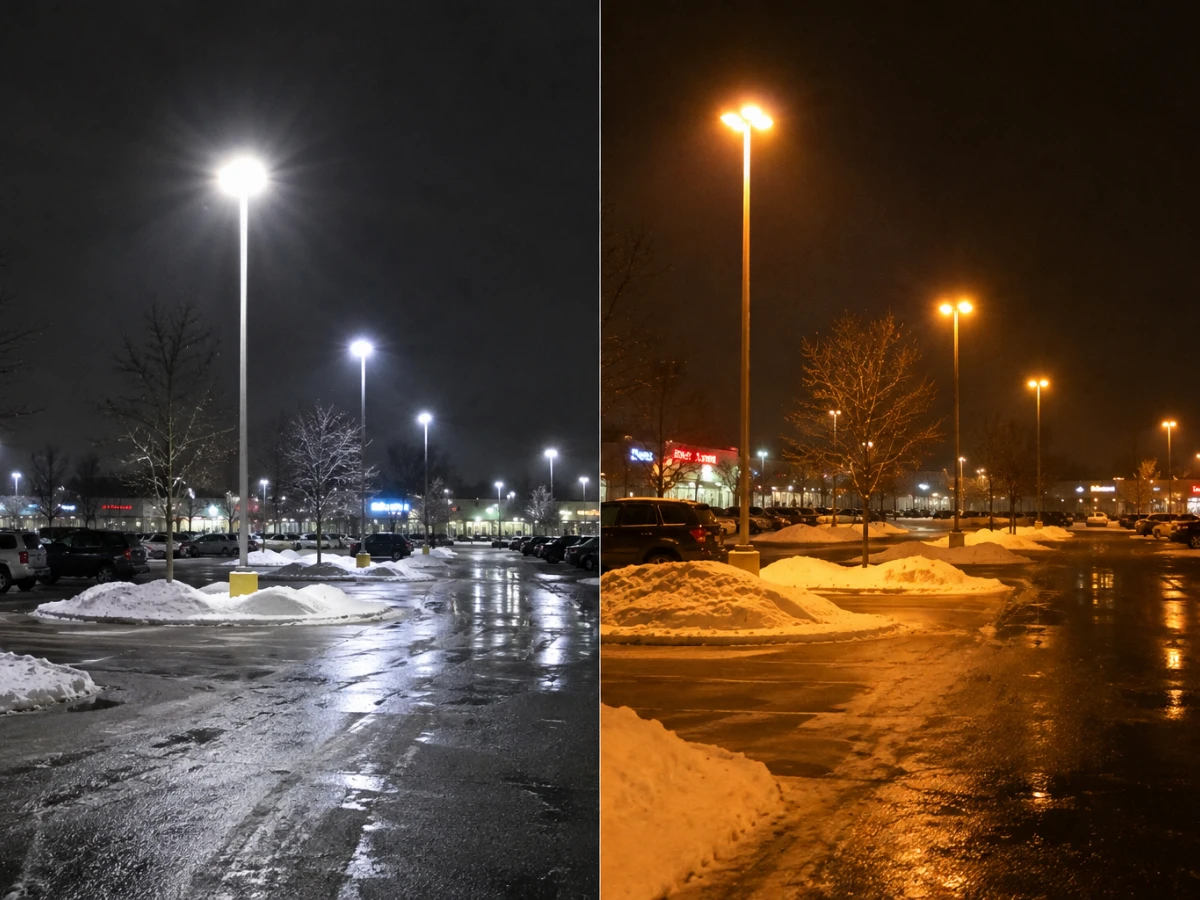
Freeze-Thaw Heave and Pole Base Stability
Here's a factor a lot of installers skip: how deep the pole base is set in the ground.
Minnesota ground freezes deep in the winter. In the Twin Cities metro, state building code requires the pole base to reach at least 42 inches below ground-level. That depth is called the ‘frost line.’ It's how deep the ground actually freezes in a typical Minnesota winter.
A pole base set shallower than 42 inches sits inside the zone that freezes and thaws every year. Here's what that does over time:
- Winter: The ground around the pole base freezes and expands.
- Spring: The ground thaws and settles back down, but not evenly.
- This freeze-and-thaw cycle repeats every year, and the movement adds up.
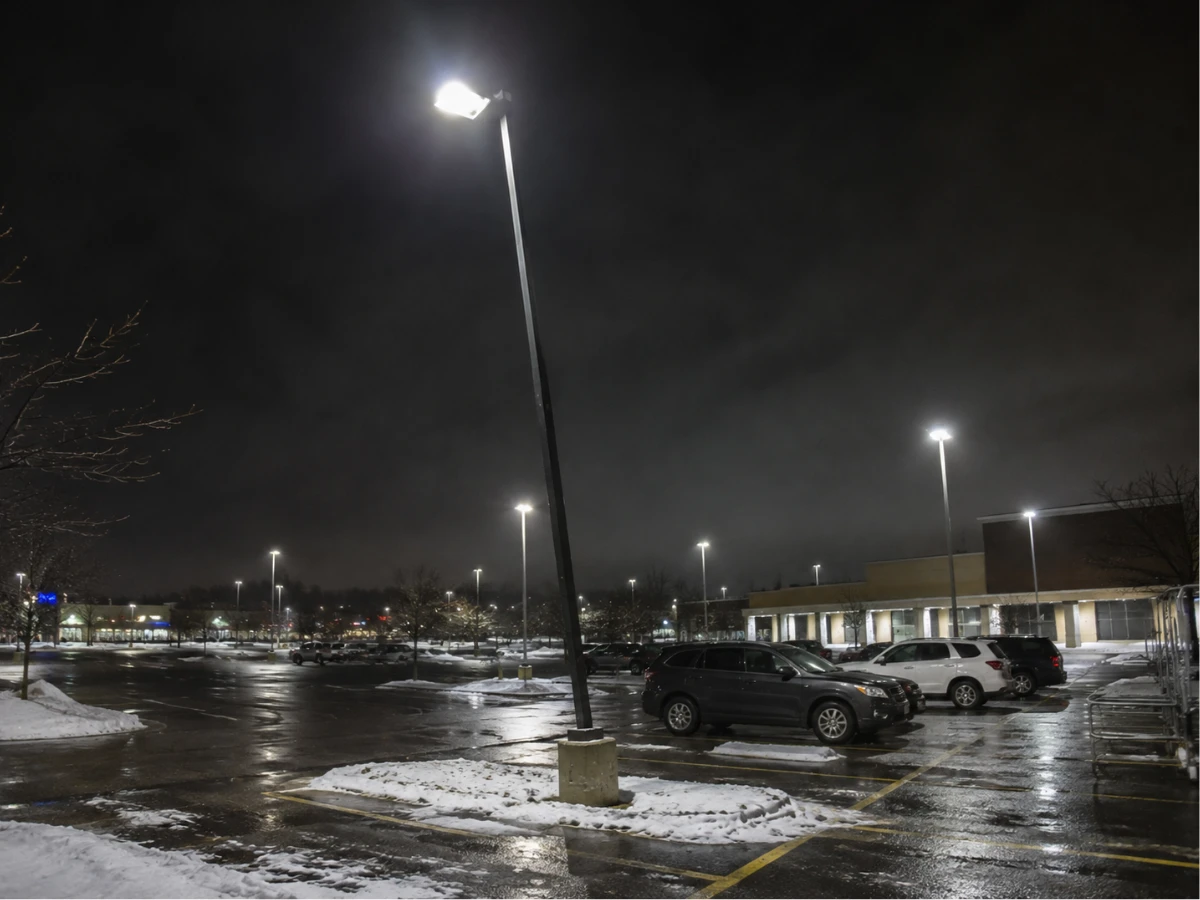
- Eventually, the pole tilts, the concrete around the pole base cracks, and the wiring running up into the fixture gets stressed.
A pole that looks fine in October could be visibly leaning by March.
This is an even bigger risk in a parking lot than on a lawn. Grass and soil get some insulation from snow sitting on top of them. Plowed, salted asphalt doesn't. Bare pavement freezes deeper and faster, so a pole base under a parking lot needs to be set at the full 42 inches to actually stay below that freeze zone.
Ice-Load Ratings for Arm Mounts
Fixture arms and mounting brackets carry more than just the weight of the fixture. Ice buildup adds real weight, and wind pushes harder against an ice-coated fixture than a bare one.
Hardware rated only for the fixture's dry weight can loosen, bend, or fail during a heavy ice event. That's exactly the kind of storm that also knocks out power, the moment a working parking lot light matters most.
Snow Reflectance
Most lighting plans are designed with a dark asphalt surface in mind. Fresh snow reflects far more light than pavement does. That sounds like a bonus, but it actually changes how a parking lot reads at night.
Reflected glare off snow can:
- Wash out contrast, making it harder to judge distances.
- Make it harder to spot ice patches on the ground.
- Make it harder to see a pedestrian stepping out between cars.
This matters most near entrances, crosswalks, and anywhere winter weather conditions can increase the risk of a slip-and-fall.
De-Icing Salt and Corrosion on Junction Boxes
Minnesota properties go through a lot of salt every winter for de-icing. Unfortunately, that salt doesn't stay on the pavement. Tires and plows kick it up onto everything nearby, including:
- Pole bases
- Junction boxes
- Handhole covers at ground level
Over a few seasons, salt exposure corrodes standard hardware, degrades gaskets, and works its way into connections that were never rated for it. This is a big reason why commercial parking lot lights for cold climates like Minnesota need corrosion-resistant hardware near ground level.
If you manage a commercial property in Bloomington, Eagan, Maple Grove, or anywhere else in the Twin Cities metro, these cold-weather factors should shape your lighting decisions from day one. Skipping this at the start means bigger problems will show up as repair bills two winters later.
Commercial Parking Lot Lighting Decisions for Minnesota’s Cold Weather
All of the problems above have a practical fix, as long as it's built into the design and maintenance plan rather than handled after something fails.
- For cold-weather fixture stress: Choose LED fixtures rated for sub-zero performance, with sealed housings and gaskets built for repeated freeze-thaw cycles. Skip fixtures designed mainly for milder climates.
- For freeze-thaw heave: Set the pole base to the full 42-inch depth required in the Twin Cities metro, not just a standard minimum. In colder parts of Minnesota or Wisconsin, the pole base may need to go even deeper.
- For ice-load risk: Use arm mounts and hardware rated with an ice-load margin built in, not just rated for the dry weight of the fixture.
- For snow glare and photometric issues: Work with a lighting design that accounts for snow reflectance. Use fixture optics and placement that control glare instead of just maximizing raw brightness near walkways and entrances.
- For salt corrosion: Use corrosion-resistant enclosures, stainless steel fasteners, and sealed handholes on any hardware installed near ground level, where salt spray collects.
- For catching problems early: Schedule an inspection every year before the snow season starts (preferably in the fall), and a follow-up check after any major ice storm or heavy plow activity.
This is also where working with a Minnesota-based licensed electrician makes a real difference. Check out our parking lot lighting services for commercial properties across the metro.
Parking Lot Lighting for Home Owner Associations (HOAs)
HOAs and condo associations face the same issues, often with tighter budgets and more resident complaints when something goes dark. We provide exterior parking lighting services for HOAs, including LED upgrades, pathway lighting, and automated controls designed for multifamily properties and condo associations.
Parking Lot Lighting Winter Weather Warning Signs
You don't need to be an electrician to catch most of these problems early. Walk your parking lot at night once in a while and look for:
- A pole that's leaning or looks slightly tilted, even a little. This usually points to freeze-thaw movement at the pole base.
- A light that flickers, or takes a long time to come on, especially on the coldest nights. This often means a loose connection or a seal that has let in moisture.
- One area of the lot that's noticeably dimmer or darker than it used to be. This can mean a fixture is failing, or that snow glare and reflectance are throwing off the light levels.
- Rust or white, chalky corrosion near the base of a pole or around a junction box. This is a sign of salt exposure working its way into the hardware.
- A cracked, foggy, or cloudy-looking lens on a fixture. This usually means moisture has gotten inside the housing.
- A dark spot that wasn't there last winter. This can point to a fixture failure, storm or plow damage, or a wiring issue that's developed since the season before.
Any one of these on its own might not be an emergency. But they're all early signs of the same underlying issues covered above, and catching them early is a lot cheaper than waiting for a full failure.
Ready to Get Ahead of Winter?
Whether it’s frost heave, ice loading, snow glare, or salt corrosion, it is easier and cheaper to design around a problem than to fix it after the fact. If your parking lot lighting has been giving you trouble in the winter, or you're planning a new install and want it done right the first time, reach out to Loch Monster Electric.
We are local, licensed electricians who specialize in building and repairing lighting systems throughout Minnesota and Wisconsin. Call us on 763-292-1191 and we can help you avoid these issues long before the snow starts falling.
Frequently Asked Questions
You can walk the lot at night at least once a month to check for dark spots, flicker, or uneven coverage. Add an extra inspection after any major snow event, ice storm, or plow activity, since that's when poles, arms, and bases are most likely to get hit or stressed.
Yes. Quality LED fixtures are built to perform in sub-zero temperatures and often start up faster in the cold than older HID lamps do. The bigger risk in winter isn't the LED itself, but moisture, ice, and salt getting into seals, connections, and pole bases around the fixture.
Yes. State building code requires the pole base in the Twin Cities metro to reach at least 42 inches below grade (ground-level), which gets it below the frost line. A pole base set shallower than that can shift with the ground every freeze-thaw cycle, eventually leading to a leaning pole or cracked concrete.
Waiting until something fails to deal with it. Frost heave, ice loading, and salt corrosion are all slow, ongoing processes. Catching them early with an inspection during the fall is a lot cheaper than an emergency repair in the middle of a January storm.