Generator Installation Plymouth MN | Backup Power Guide for Older Homes
Updated: Oct 15, 2026
This guide covers generator installation in Plymouth, MN, including cost breakdowns, why older 1970s–1990s wiring and panels create unique challenges, sizing and fuel choices, transfer switches, Minnesota permit and code rules, Xcel Energy requirements, placement setbacks, and maintenance tips.
It's 15 degrees outside, the ice storm just tore down the power lines, and your furnace blower has gone quiet. If you live in an older home in Plymouth, that's going to be a stressful night … unless you have a generator.
This guide walks you through what generator installation in Plymouth really involves. We cover cost drivers, older-home wiring, sizing, permits, Xcel Energy rules, fuel choices, generator placement, and maintenance. That way you know exactly what to expect before you buy one.
We're Loch Monster Electric, licensed electricians serving Minnesota and Wisconsin. We have seen the same electrical problems in a lot of homes built from the 1970s to the 1990s. The generator installation isn't the hard part. Getting it to work safely with the wiring already in the walls is.
Ready to get started? Call us at 763-292-1191 or fill out our contact form.
Standby Generator Installation Cost in Plymouth MN
Here's a general breakdown of what a standby generator installation in Plymouth will cost you.
Item | Estimated Cost |
Standby Generator Unit | $5,800 |
Parts | $750 - $2,200 |
Professional Labor (10 to 16 hours) | $2,100 – $3,200 |
Total Project Estimate | $8,650 – $11,200 |
Important Note: These numbers are just estimates. Your final price depends on your home. Costs can change based on your wiring, how easy it is to reach your electrical panel, utility rules, and local city codes.
In 1970s to 1990s Plymouth homes, tight yards and gas line updates can also push the price higher. We need to visit your property before giving you an exact quote.
Why Plymouth's Older Homes Create Unique Generator Challenges
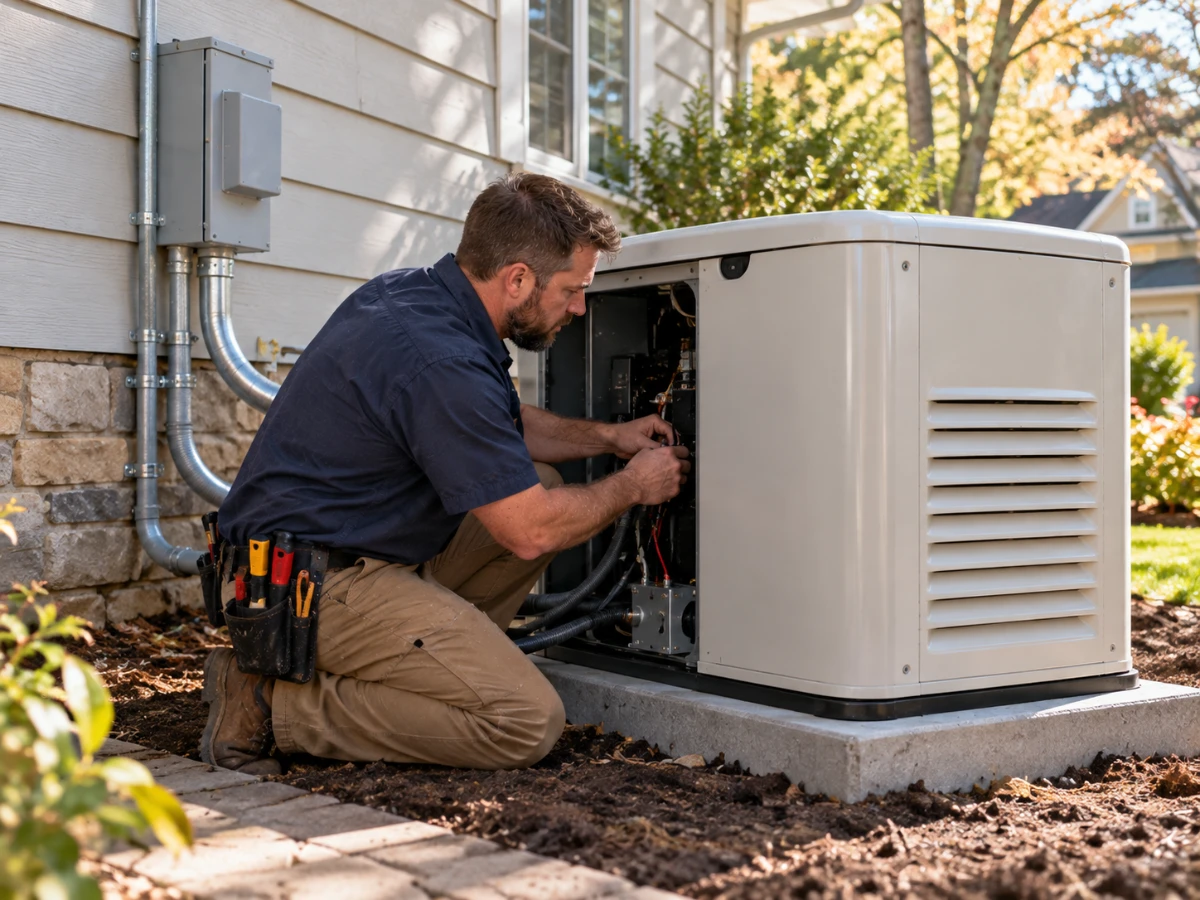
Plymouth neighborhoods like Timber Shores, Four Seasons, and the area around Bass Lake are full of homes from the 1970s through the 1990s. Many were wired for a lot less power than we use today.
Here's what we often find:
- Smaller panels: A 100-amp or 150-amp service is common. Some homes have panels with a poor track record, like Federal Pacific or Zinsco. They weren't formally recalled, but they have a known failure history.
- Older branch wiring: Some early 1970s homes may have aluminum branch wiring, which needs extra care at connections.
- Non-electric heat: Gas furnaces and boilers still need electricity for the ignition, blower, and controls. No power here means no heat.
Putting those three things together, and you can see the challenge you’re dealing with. You can't just bolt a generator onto an older system and expect it to work. The panel has to be able to handle the connection safely, the wiring has to be up to code, and since the home relies on electricity to run the heat, the generator has to be sized to cover it.
We thoroughly check each of these before we recommend any equipment, so the system you end up with actually matches your home. Not sure about your home wiring? Our how to know if your house needs a rewiring guide covers seven warning signs to watch for in an older home.
Whole-Home vs. Partial-Home Generator: What Makes Sense?
Most Plymouth homes are about 1,500 to 3,000 square feet, from ramblers to two-stories. Your choice of generator comes down to what you can't live without during a power outage.
Option | What it usually covers | Good fit if | Watch out for |
Essential circuits | Furnace, sump pump, fridge, some lights and outlets | You want heat and a dry basement | No central air or big appliances |
Partial-home | Essentials plus a few larger loads | You want more comfort but have a gas-heated home | Load management may be needed |
Whole-home | Nearly everything in the panel | You have electric heat, a well, or medical needs | Larger unit and more installation work |
Plymouth has lakeside and low-lying lots, and a dead sump pump during a thaw can flood a basement fast, making it an essential item to power. Homes in outlying areas may also have well pumps, and this requirement pushes you toward an even bigger unit.
Whole-home generator units make sense when you have electric heat, central air, an EV charger, or medical equipment. If you have gas heat, a smaller partial-home system often does the job.
How to Size a Generator for a 1970s–1990s Plymouth Home
We size the generator you need by adding up what you want running at the same time, and then accounting for startup surges. We do this with a proper load calculation, not a guess.
Here's what we look at:
- Heating type: A gas furnace with an electric ignition and blower needs far less power than an electric furnace or heat pump. Since most Plymouth homes run on gas heat, this often keeps your generator size and cost down.
- Sump pump surge: These pump motors pull extra power for a moment when they start, sometimes several times their normal running wattage. The generator has to be sized for that spike, not just the pump's everyday draw.
- Refrigeration: Fridges and freezers also have startup surges, and losing power to them for too long during an outage means losing what's inside.
- Medical equipment: Oxygen concentrators, dialysis equipment, and similar devices should be on your must-run list, since these often can't go without power at all.
- EV chargers: Most people leave these off the backup list, or use load management to handle this, since charging a car can pull as much power as the rest of the house combined.
Transfer Switches, Interlock Kits, and Panel Work
A generator has to be installed properly, so power never flows back onto the utility lines. You have three main options to do this:
- Automatic transfer switch (ATS): This detects the outage, starts the generator, and switches power on its own.
- Manual transfer switch: Requires you to flip the switch yourself. It's simple and often more affordable.
- Interlock kit: A mechanical safety device which prevents the utility main breaker and generator backfeed breaker from being turned on at the same time. This is a code-approved option on some panels, but it has to be the kit listed for your exact panel.
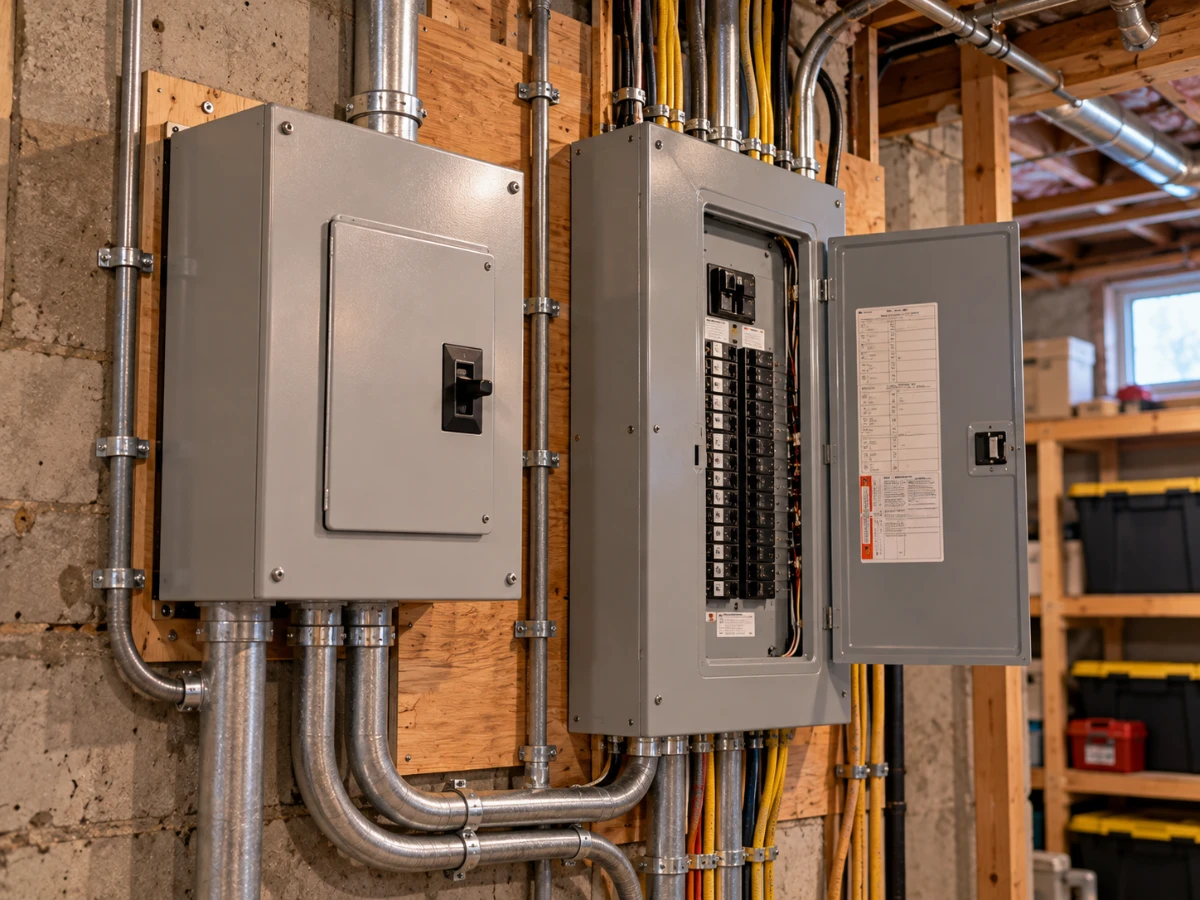
Here's where older homes get tricky. If your panel is an original 100-amp, or a Federal Pacific or Zinsco type, it may not be safe to tie a generator into it. Sometimes no approved interlock kit even exists for the panel. In that case, a panel upgrade comes first. We recommend this because connecting a generator to a panel with a poor safety record isn't something we'd do in our own homes.
To learn what that upgrade involves, read our 200 amp panel upgrade guide which breaks down costs, permits, and what happens on install day.
Propane vs. Natural Gas Generators
Most Plymouth neighborhoods already have natural gas. Here's how the two generator fuels compare:
- Natural gas: No tank to fill or store, since it runs off your home's existing gas line. The tradeoff is that your backup power depends on the gas grid staying up, which is rare but not impossible during a major storm.
- Propane: Fully independent of the gas grid, since it runs off a tank on your property. You'll need to size that tank for how long you want backup power to last, and find a suitable spot for it that meets code. On tight lots, this can be a squeeze.
Tank placement has its own distance rules from your house, property line, and gas meter, so check them before you commit to the installation.
Cold weather matters too, since propane can lose pressure in deep freezes. This makes adequate tank size and insulation important, especially for a system you're counting on to work during a Minnesota winter.
Generator Placement, Zoning Setbacks, and HOA Rules in Plymouth
Where the generator is installed matters a great deal for safety. The generator exhaust includes carbon monoxide, which you can't see or smell, and is lethal to inhale. This has to be kept away from windows, doors, and vents.
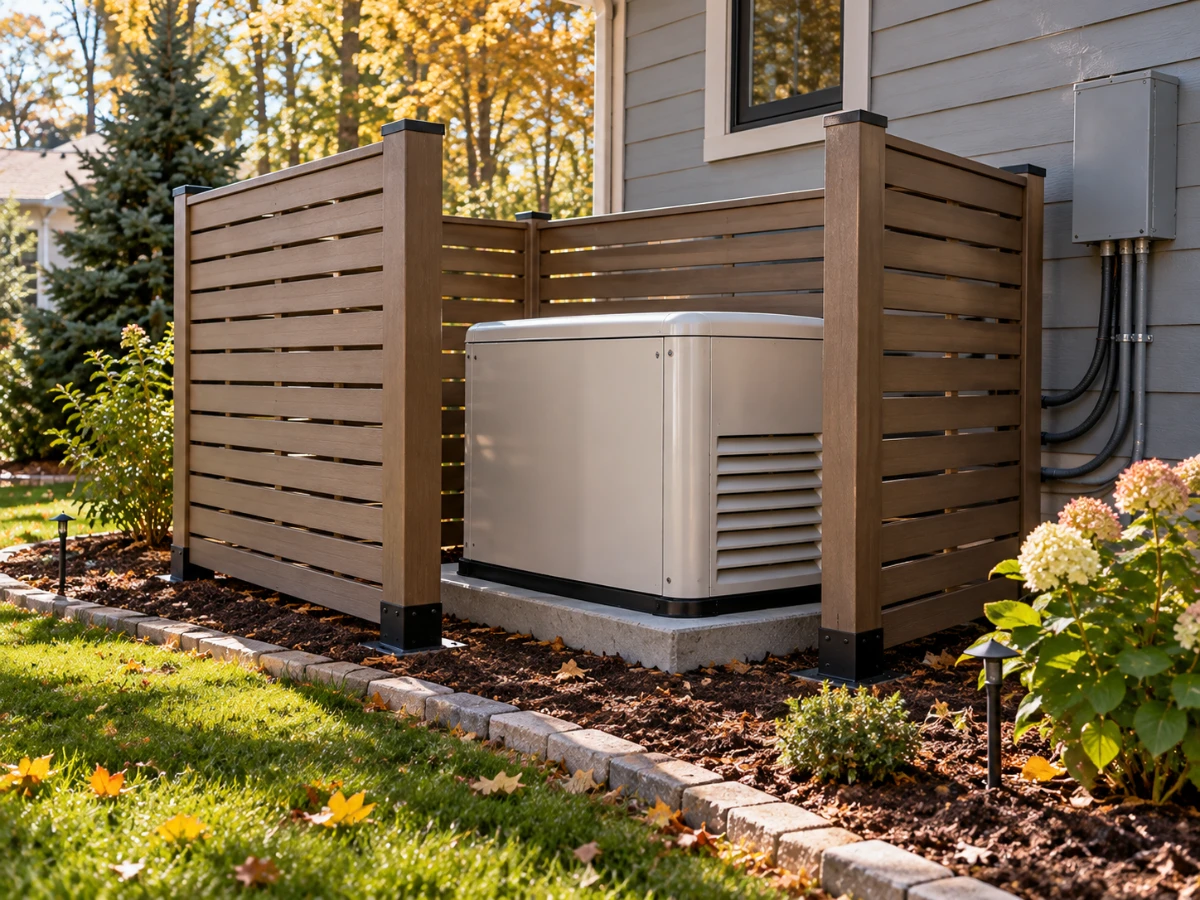
Plymouth also has zoning rules for how close equipment can be to property lines, so tight lots can limit your choices. Check the city's zoning code, or ask us to help with the site plan when you’re deciding where to place the generator. We can also look at where the gas meter and electric meter need to be installed.
If you live in an HOA neighborhood, you may be required to get board approval for permanent generators. Some HOAs may require screening or landscaping to keep the unit hidden from your neighbours or from the street.
Xcel Energy Requirements for Generator Installation
Most Plymouth homes get electric service from Xcel Energy. A standby generator with a proper transfer switch doesn't send power back to the grid. This is called anti-islanding, and makes sure the utility line crews don’t get shocked by power coming back from your house.
Xcel's own guidelines describe this kind of standby setup as one that doesn't run in parallel with the utility. This is also a requirement according to the NEC Article 702 (more on the NEC in the next section), and Xcel may want proof that your generator installation has passed inspection.
Minnesota Permit and Code Requirements in Plymouth
There are two things to know before you install a standby generator in Plymouth: what the code requires, and what the city needs from you on paper.
NEC Rules for Standby Generators
Minnesota's electrical code, which follows the National Electrical Code (NEC), has specific rules for standby systems. During inspection, the city checks that your transfer switch, wiring, and grounding all meet those requirements. If your project also needs new gas piping, that needs its own mechanical permit.
Minnesota doesn't require you to bring your home's existing wiring up to current code just because it's old. But any new or altered circuits do have to meet it, and a generator hookup counts as new work. That's why the inspection is a mandatory part of the process, and not just paperwork.
Electrical Permits for Standby Generators
You'll need an electrical permit before installing a standby generator in Plymouth, since it counts as new wiring and equipment on your system. The city can often issue residential electrical permits right at the application stage, and then schedules inspections as the work moves along.
Skipping the permit is a bad idea. Unpermitted work can cause trouble with insurance claims and slow down a home sale. Our electrical permit requirements in Minnesota guide explains which projects need permits, the homeowner exemption, and what happens if you skip the process.
What to Expect During the Generator Installation in Plymouth
- Site visit and load calculation: We check your panel, wiring, and yard, and plan around three questions: Is the wiring safe to connect? How will the transfer switch handle the neutral and ground so the system stays properly bonded? And which loads can we realistically back up? We look at these before we pick any equipment.
- Permit: We file it with the city on your behalf, so you don't have to deal with the paperwork.
- Pad and placement: We prep a solid pad for the generator to sit on, in a spot that meets code and clears your gas meter, windows, and property line.
- Gas line or propane hookup: A licensed gas pro runs the fuel line or connects the propane tank. This piece isn't something we handle ourselves.
- Electrical work: We mount the transfer switch near your panel, and run the wiring between the generator, the switch and the panel. This includes connecting the home circuits you've chosen to back up and making sure the switch is wired to shift between grid power and generator power cleanly. We also handle anything flagged during the site visit, like older wiring or a panel that needs extra care, so the whole connection is safe and code-compliant.
- Inspection: The city inspector checks the completed work and signs off before the system goes live.
- Startup and test: We fire up the generator and run through a full test, so you know it'll actually work when the power goes out.
Generator Maintenance in Minnesota's Climate
A generator that never gets serviced can fail on the coldest night of the year. Most standby units run a short self-test each week. Beyond that, we cover a yearly service, where we check:
- The weekly self-test results, to catch problems early.
- Oil and filters, changed on the schedule the manufacturer recommends.
- The battery, especially before winter, since the winter cold is hard on batteries.
- Snow and ice buildup around the unit and its vents.
- Fuel supply, including propane tank level.
- The transfer switch, tested to confirm it's still working correctly.
Loch Monster Electric serves Plymouth for ongoing service calls too, so you're not on your own once the generator is installed.
Get Your Plymouth Home Ready Before the Next Storm
Backup power works best when it's planned around your home. Loch Monster Electric is the licensed electrician that can handle the electrical side of it, from the site check to the final inspection.
To talk about electrical service in Plymouth and nearby cities like Maple Grove and Eden Prairie, call us at 763-292-1191.
Frequently Asked Questions
Most standby generator installations in Plymouth run between $8,650 and $11,200, covering the unit, parts, and labor. Your final price depends on the generator size, the transfer switch, fuel setup, and any panel work. Older homes often cost more because of wiring and panel needs. We give exact numbers after a site visit.
Yes. Plymouth requires an electrical permit for this kind of work. Timing depends on the project and the city's workload. The Plymouth Building Inspection Division can be contacted for more details.
Sometimes, but not always. It depends on the panel brand, its condition, and whether an approved transfer method exists. Some older panels need to be upgraded first.
It depends on your heat type and what you want to run. A gas-heated home often needs less capacity than an all-electric one. We can perform a load calculation to give you a more accurate answer.
Distances depend on the manufacturer's instructions, code, and Plymouth's zoning rules. This needs to be confirmed with the city before you pick a spot.
Standby generators are allowed when they're installed to code with a proper transfer switch. There are currently no rebate programs from Xcel Energy.
The on-site work often takes a couple of days. Equipment delivery, permit review, and inspection scheduling will stretch out the full timeline.